How can I help?
Sighted guiding, shopping, community participation, and audio description at the movies.
Read the everyday assistance guide AdvocateDadCO
Practical tools for families
Find reliable information, prepare for a meeting, understand disability-specific evaluations, or plan for education, work, and adult life.
Find help with blindness and low vision
Search practical lessons by everyday goals, tools, or skills. Build a small skill plan and schedule practice. For families, teachers, and caseworkers.
Practical access
Offer assistance with confidence, follow the person’s lead, and remove barriers at school, in stores, at church, and in the community.
Sighted guiding, shopping, community participation, and audio description at the movies.
Read the everyday assistance guideBring blindness and low-vision access into your existing work as a paraeducator, teacher, or related service provider.
Explore professional access strategies and resourcesLearning, practice, and transition
Learning and transition resources · Accessible STEM resources · Accessible meetings toolkit
For families, paraeducators, teachers, related service providers, and rehabilitation professionals. Choose a resource that fits the learner and the task, then bring the ideas back to the student and team.
Self-paced professional and family learning
The American Printing House for the Blind offers free online courses for educators and families, including early childhood and Expanded Core Curriculum topics. An account is needed to enroll. Check each course for its requirements and available professional credit.
For product demonstrations and other webinars, browse APH Access Academy and webinar archives.
Recorded student lessons
APH’s archived lessons offer student-focused learning activities that families and educators can explore. Use the recordings as a source of ideas and practice; check the activity’s age range, materials, and fit for the learner. This link is an archive, not a current live-program schedule.
Research, employment, and professional learning
The National Research and Training Center on Blindness and Low Vision connects research with employment, independent living, training, and technical assistance. It offers resources for people who are blind or have low vision, families, service providers, and employers.
Explore the NRTC resource hub · Find NRTC training and free online courses
Choose courses and resources by audience; check individual registration and credit requirements.
Families, young people, and transition teams
NRTC’s free resource helps families build skills toward employment and independent living across ages 4–24. It includes information, activities, and resource links, with content for blindness/low vision and for deafblindness with additional disabilities.
Learn about 4to24 · Open the 4to24 web app
Family and student accounts provide content over time. Follow the current web-app installation guidance. Professionals can review the separate professional-portal access process.
Short demonstrations of accessible math workflows
CATT’s Tech in 20 series provides 20-minute demonstrations of math access using assistive technology from APH. Topics include Desmos with JAWS, accessible math materials, tactile graphics, and Monarch-ready charts and graphs.
Find Tech in 20 sessions, recordings, and math resources
Free and open to all. Register through the provider for live sessions and the full session-resource document. The series does not offer continuing education units (CEUs).
Early intervention and multiple disabilities
Utah State University’s SKI-HI Institute developed INSITE for young children with vision impairments and additional disabilities, including hearing loss, and their families. Its intervention model, curriculum, and training are relevant to early-intervention teams planning individualized family support.
Learn about Project INSITE and SKI-HI resources
Check current training and curriculum availability with the provider. Project INSITE is a different program from the Project INSPIRE braille STEM collection already featured here.
Eye health, advocacy, and living with vision loss
Eye-health and safety information, advocacy resources, and support for people living with vision loss. Its Living Well With Low Vision collection includes directories for services, transportation, assistive technology, and accessible reading materials.
Explore Prevent Blindness · Browse Living Well With Low Vision resources
Learn about the ASPECT patient engagement and advocacy program. Check current participation and program details with the provider.
These resources support learning and collaboration. They do not replace individualized evaluation or instruction from qualified professionals. A course certificate alone does not establish a blindness-specialist credential. Provider offerings and access conditions can change. Links reviewed November 9, 2026.
Science, technology, engineering, and math
Explore resources discussed in Dr. Tiffany Wild’s “Shooting for the Stars: Making Science Accessible” session. Use them to plan hands-on participation, usable information, and meaningful roles in science.
Plan tools, instruction, communication, and safety with the student and qualified team before a lab or construction activity. Check older resources for changed equipment and links. Start with the scientific concept and the student’s participation; choose access methods that let the student investigate and demonstrate learning.
Conferences, meetings, and community events
A free planning resource developed by the Johns Hopkins Disability Health Research Center and the International Network of Researchers with Visual Impairments and their Allies (INOVA). It offers guidance for organizers, staff, presenters, and attendees, including planning before an event, access during sessions, and follow-up afterward.
Use it as a starting point when planning a conference, school meeting, church event, or community gathering. Consider registration, venue access, usable materials, presentations, and how people will request and receive support.
Get the INOVA toolkit and one-page flyers from Johns Hopkins — English, Spanish, German, and French editions are listed on the provider’s page.
Read the Partners for Sight introduction to the toolkit · Explore everyday community access guidance
Family guides
Read all three guides online without entering an email address. Newsletter signup is optional. Five-page print editions are also available. The online editions support text resizing and assistive technology. The PDF editions are designed for printing and are not certified as tagged accessible PDFs.
Free to share for educational and advocacy purposes with attribution. Please credit Rob Harris / AdvocateDadCO and retain the original source link.
Individualized education program meetings
Set priorities, review disability-specific instruction, and leave the meeting with clear next steps.
Evaluation
Understand vision-specific assessments and the questions that connect evaluation to educational need.
Skills and transition
Connect the nine Expanded Core Curriculum areas to the student’s goals for education, work, travel, and community life.
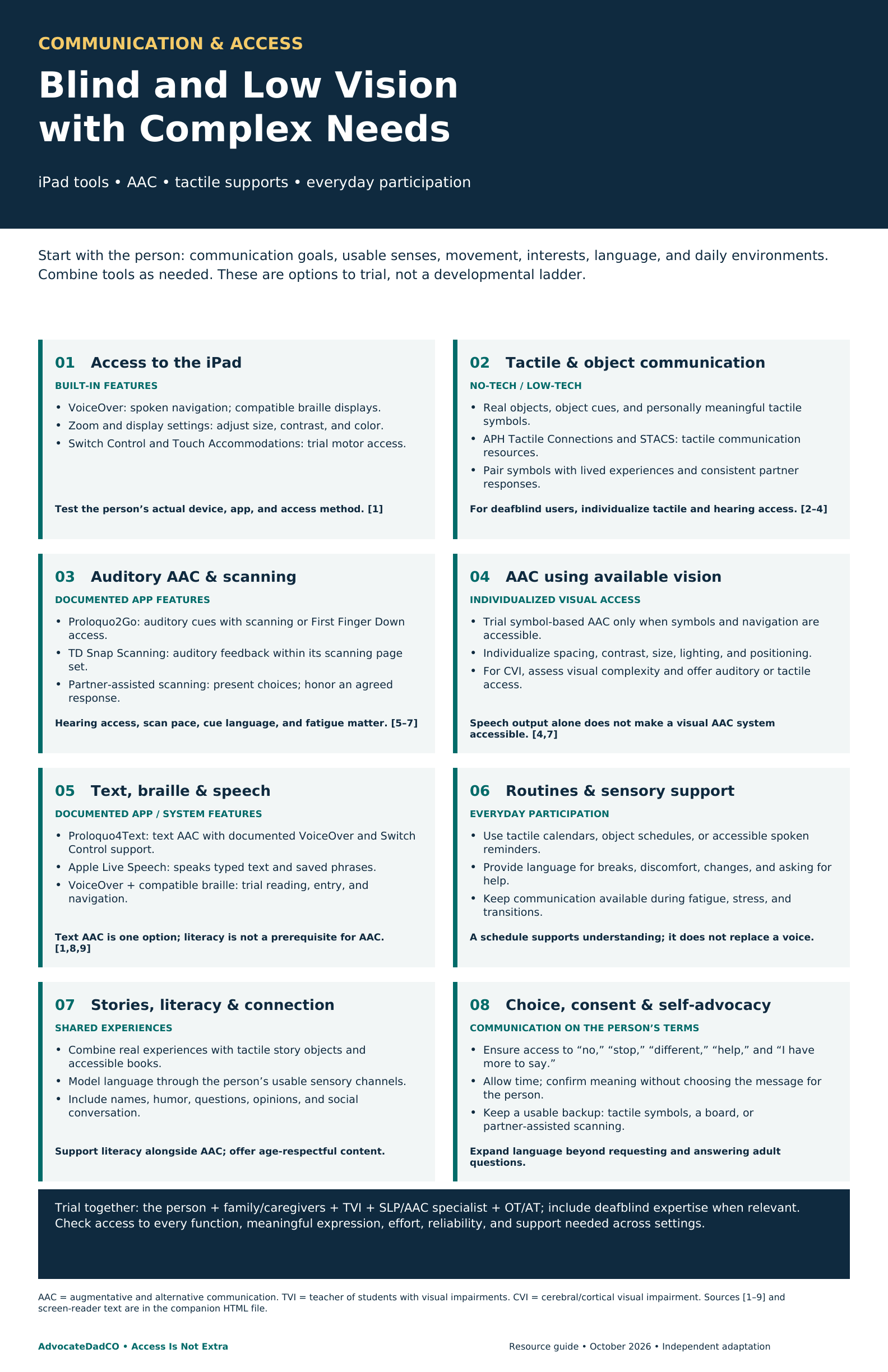
Featured resource · Blind and low vision · Complex needs
Explore communication and participation supports for blind and low vision people with complex needs. This AdvocateDadCO guide brings together iPad accessibility, augmentative and alternative communication (AAC), tactile and object communication, auditory scanning, text and braille, routines, literacy, and self-advocacy.
For families, caregivers, teachers of students with visual impairments, speech-language pathologists, assistive technology teams, and other support professionals. Use it to compare options and plan an individualized trial.
Free to read and download. No email required. The online guide supports screen readers and text resizing; the PDF is designed for printing. Includes publisher sources and questions to guide a trial. Published October 2026.
Featured collection · Braille STEM
Free braille STEM professional development and student programs that strengthened Isabelle’s education and our family’s advocacy. Read the AdvocateDadCO feature, then go straight to the Paths to Literacy resources—no PDF gate.
Trusted resource · Literacy and music
Free braille and audiobook library services for eligible readers, including people who are blind or have low vision and people with qualifying print disabilities. During our Washington, D.C., advocacy trip, Isabelle and I experienced a custom tour with tactile access and met with NLS leadership. These resources bring reading, learning, and music into everyday life.
Explore NLS Music Service and Materials · Request Braille on Demand books · Learn about NLS and enrollment
Already an NLS patron? Contact the Music Section at nlsm@loc.gov or 800-424-8567, extension 2. Music services are requested directly from NLS.
Literacy for all. Including the music.
Open access · ONH
Find 28 curated resources covering medical care, hormone monitoring, family support, education, research, and Colorado services. Includes questions to bring to appointments and school meetings.
Family support · Epilepsy
PESA supports families of children with drug-resistant epilepsy before and after surgery, with parent support navigators, education resources, and help finding services. For families navigating ONH alongside epilepsy, these resources can help connect medical care, school, and everyday support.
Explore PESA’s resources and family support
Featured guide from PESA
PESA’s curated guide covers surgery preparation and recovery, school supports, therapies, transition to adulthood, caregiver support, and financial resources. PESA notes that many resources also help families managing drug-resistant epilepsy whose child has not had surgery.
Read PESA’s introduction and access The (Almost) Everything List
Read “When ONH and epilepsy overlap” in the ONH resource hub
Open access · Colorado
Find concrete next steps and checked resource contacts for dyslexia, individualized education programs (IEPs), Medicaid, caregiving, health care, and adult life. Includes the Dyslexia Foundation of Western Colorado and the family guides on this page.
Explore Colorado questions and resources — no email required
We count selections of resource links to help improve this collection. The counter records a resource label, the page it was selected from, and the time. It does not store IP addresses, names, cookies, or visitor profiles in the resource dataset. Your browser still connects to Cloudflare, our hosting provider. Global Privacy Control and Do Not Track signals turn this counter off. Counts describe link selections, not whether someone completed a course or used a service.